Analog processes
- elle walker

- May 8, 2020
- 4 min read
Updated: Feb 21, 2021
With the recent nice weather I took the opportunity to create some traditional analogue processes: lumens, cyanotypes and gum bichromates.
Lumens
A lumens print is created by placing an object, often fresh plant life or some other object, onto light sensitive paper and placing in bright sunlight or under a UV lamp. The UV light reacts with the chemicals within the paper and ‘burns’ the paper, leaving am imprint of the object placed upon it. A number of prominent twentieth artists like Many Ray and Pablo Picasso created lumens – often called photograms – within their practice.
First up were the lumens. They are very simple to create and beyond the physical resources of assorted objects or plant life and photographic paper, the only other requirements are time and bright sunlight.


I used two A5 frames for this process but the frame size and paper size didn’t align correctly: the horizontal line on the top of the rose leaves image and the banding at the base of the bay leaves image are the result of the paper slipping inside the frame.
The following day I created these two, this time using a single A4 frame. This worked much better as the clips for the frame were sturdier than those used for the A5 frames, resulting in a much more secure fit with no room for the paper slip around.

During my government sanctioned daily exercise I found a sprig of bluebells lying on the path, so I took them home. I used the A4 frame again and created these:


Although I love the very natural effect and the simple buff coloured background, I wanted to change the colour to see the effect.


I made the bare minimum of adjustments in Camera Raw, by dropping the temperature, the exposure and the shadows slightly until I found a particular shade of blue that I liked.
Making colour and tone adjustments will allow for more creative freedom, however, I prefer to keep this particular process as close to analog as possible, flaws and all.
Cyanotypes
Though invented by Sir John Herschel in 1842, the cyanotype process was popularised by Anna Atkins as a method for illustrating her book of algae in Photographs of British Algae: Cyanotype Impressions in 1843. The cyanotype process is a contact process, made by placing objects or plant life directly onto paper treated with a solution of ferric ammonium citrate and potassium ferricyanide and exposing to UV light for a short period of time. The result is an image that remains white where the object has been placed on the paper, with the areas exposed to the UV light turning a vivid blue (cyan).
My first two cyanotypes were portraits. Both photographs were originally taken with an iPhone.


A sheet of A4 Seawhite watercolour paper was treated with the cyanotype solution and left to dry in the dark.
The images were edited in Photoshop: enhancements to contrast and exposure to ensure a strong negative and then the images were inverted.


A digital negative was made by printing the inverted image on PermaJet Digital Transfer Film.
The negative was placed directly in bright sunshine for 30 minutes, then washed under cold water. I was a little vigorous with the washing which resulted in scratches forming on the paper, but remarkably, the scratches enhance the vintage feel of the images.


The next set were also portraits. These created on a day that had consistent but weak sunshine, so I was unsure as to what the exposure time should be. I again used thirty minutes but surprisingly, given how weak the sun was on this day, the images are over exposed.


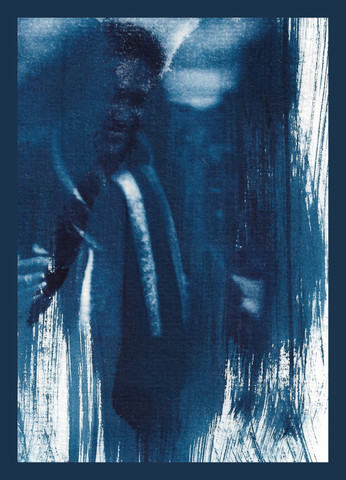
A border was added in Photoshop, using the colour picker to match the colour taken from the image. These portraits were exposed for 30 minutes.


Next came some flora.

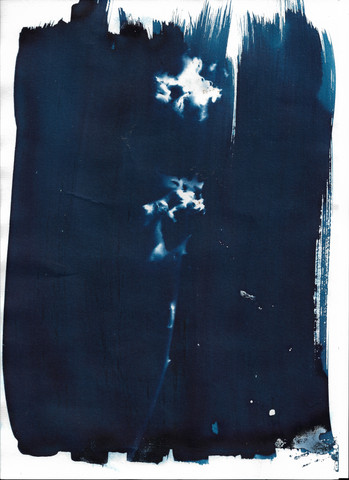

The image on the left was a sprig of magnolia blossom which was exposed for 30 minutes. The image on the right was a found image from an online search and was exposed for 25 minutes. Because of the strong contrast it produced one of the better images.
The most difficult aspect of creating cyanotypes is estimating the exposure time. Even though the weather conditions were sometimes hazy with weak sunlight, it was still powerful enough to overexpose the magnolia blossom. I’ll recreate the portraits again, as I still have the negatives, however, I’ll experiment with a thinner coating of cyanotype solution on the paper and shorter exposure times.
Gum bichromate
I was feeling really lucky with the progress of creating cyanotypes, so I decided to create a gum bichromate image. I decided I was going to use one of the exiting negatives I had already made, so I could compare and contrast the cyanotype process and the gum bichromate process but using the same negative for each process.
I treated the paper and let it dry, but it took several hours to dry properly. With the benefit of hindsight, I attribute this to the rather heavy coating of solution I used.


The negative has strong areas of contrast so I thought this would work well, but I was wrong. The stripes on my top can just about be seen, but not much else.
This piece of paper was treated and left to dry but unfortunately, due to the change in weather from bright and sunny to consistently raining, I wasn’t able to use it for six days. I had stored it in a light proof bag until I could use it, so the lack of detail in the image is either down to too thick a coating of solution on the paper, a poor negative, or possibly a combination of the two.
I used the same negative to create a cyanotype, with similar results: lack of detail, except for parts of my face and my top.
I intend to recreate the experiment again – one negative, two processes – but I’ll ensure the negative is stronger and has more contrast than my previous attempt. The only thing I won’t be able to control is the weather.


Comments