FMP: Final idea
- elle walker

- Apr 2, 2020
- 5 min read
The title of this work is 14:00.
A virus outbreak in Wuhan, China, was reported to the World Health Organization on 31 December 2019. By January 2020, WHO declared it a pandemic. The following month, it was given a name: COVID19. On 23 March 2020 the UK Government announced measures to try to stem the rising rate of infection: the main step was that the nation would be under lockdown. Having already shut down cafés, bar, pubs and restaurants, all social contact was to be off-limits and non-essential trips outside the home to be outlawed. The entire nation, where possible, was to self-isolate. Key workers, such as NHS staff, first responders and those in the essential industries such as food retail and utility supply, were to continue to work as normal and others were to work from home where possible. Many industries had to lay off or furlough staff because keeping them on the payroll was not financially viable. As a result, millions of people of all ages became housebound and are now facing the reality of weeks, if not months, in their home, either alone or with family.
I share my home with my son, a very gregarious person, who, one week into lockdown, was struggling with the lack of social freedom and contact. Our living room, like many others, is the centre of our life: it is a workout space, a place to entertain, somewhere to read, watch television, play games and listen to music. Ordinarily, the living room only sees this much activity of a weekend, but the new normal is being in the house and the living room in particular, for several hours a day, every day. What this project will do is to document what is happening in our living room, by taking a single photograph at 2pm every day, for thirty days. I decided on 2 pm because the mornings are usually taken up by household chores and studying and it’s not until the afternoon that we begin to think about how to occupy ourselves for the day.
This will not only show what is happening in the living room but also capture the mood of having to conduct life within the same four walls for a month. If on any given day no-one is home, due to taking the allowed one hour of outdoor exercise, or shopping or checking on a vulnerable family member, then there will be a blank frame in lieu of an image.
Showing the images in chronological order is crucial to the context of the series to enable the audience to experience time in a similar fashion to how it was experienced at home. The series will be presented in a book, as this will show the images in chronological order. They could also be presented in a gallery, but single images would lose meaning, so they would have to be presented as a linear, horizontal banner in a gallery. The final option is to show the work online. In this case, the work will be placed vertically; the viewer is then free to scroll through the images one at a time at their leisure.

Hellen Van Meene has a simple convention of identifying her images simply as the number in which they were taken. The lack of titles does not detract from the viewing experience as it forces the audience to make their own interpretation of what they see before them.
The work will be created digitally, as under current circumstances, processing film is a difficult endeavour. Polaroid film is another option, but the cost would be prohibitive: five packs of black and white film containing eight frames per pack (a total of 40 frames, to allow 10 frames for contingency purposes) would cost c£78, excluding posting and packaging.

Anton Kusters’ The Blue Skies Project (2018) is a beautifully rendered work, showing the skies above the last known location of 1078 Nazi concentration camps. Each frame is embedded with an ID reference and the GPS coordinates of the camp. The images show a series of cyan-coloured frames, that out of context, could be taken a s a study of the colour blue. It’s only when the context is known that the beauty gives way to horror. Although 14.00 will be a digital project, I may add the occasional black and white Polaroid print, to provide a comparison between the digital and film images.

The camera will be placed on a tripod in the same position – using tape to make marks on the floor for the position of the tripod - to ensure consistency of framing across all images. The images will either be black and white or a very muted colour palette which will suggest the stark reality of living with a pandemic and will have large borders to convey a sense of being constrained. Should whomever is present in the frame on that particular day be experiencing negative emotions, then the edit will reflect that: testing has been set for a future date to determine the editing techniques that will be employed as well as the size of the images.
No studio or other location is required as the entire project will be undertaken in my home.
A total of 46 days has been planned for the project, to cover testing, initial evaluation and peer feedback, followed by final shooting, editing, evaluation and final peer feedback. This will allow 14 days clear before the submission deadline, which will be used for contingency, should it be required.
I’m drawn to the idea of a square book with matte paper; the images themselves will be centrally placed on the page, leaving a large amount of white space around it. The square format will represent the compressed life that people worldwide have to ensure because of the pandemic.
A photobook printed via Blurb will cost c£50.00 for a 32-page 18cm x 18 cm layflat book with an image wrapped cover, with 432 gsm ultra-thick paper. Blurb have a solid reputation of offering high quality photobook solutions, so they are my first choice, although they appear to be one of the most expensive.
Cewe offer a 21 cm x 21 cm hardcover photobook on matte photographic paper with layflat binding for c£40, for up to 98 pages.


Masahisa Fukase (1934-2012) photographed his wife Yohko Wanibe every day for 12 years as she left their apartment for work. Following the breakdown of their marriage, he photographed ravens over a ten-year period, creating The Solitude of Ravens (1986).

This approach can be seen as inspiration for a scene in the film Smoke (1995), in which a character takes a single photograph of his tobacconist shop every day at the same time, from the same location across the street.


Stephen Shore (b.1947) created American Surfaces(1972-1973) during a road trip across Route 66 and took photographs of every meal he ate, every bed he slept in and every town he encountered during his trip. He wanted to create snapshots of his life at the time and thus the images were “small snapshot prints”, presented in grid form.


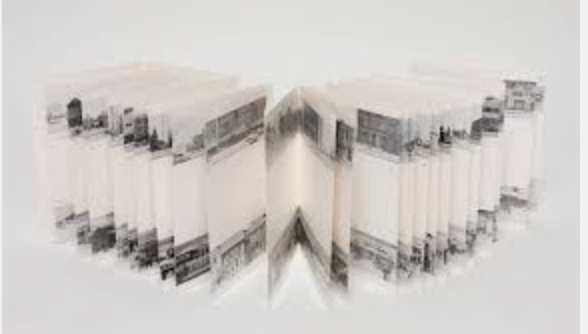
Ed Ruscha created many projects photographing banal scenes and objects. Every Building on the Sunset Strip (1966), is a literal arrangement of Ruscha’s journey across a famed thoroughfare - office buildings, bars, shops – that any individual could encounter for themselves, however, Ruscha’s genius idea was in the presentation. Published as a concertina book, the reader, when folding out the pages, was presented with a 25-foot-long image containing two panoramas, representing each side of the road.

Above and below: Every Building on the Sunset Strip (1966), Ed Ruscha
These photographers had committed to documenting what could be seen as interpreted as banal subjects, but when presented as a complete project, the work takes on more meaning. My images will be an accurate representation of life in early 2020: repetitive, constrained, suffocating and bleak, but hopefully, there will also be some moments of joy and hope too.


excellent research and understanding of photographers who have used a diaristic format, along with researching costs for books.